The Complete Guide to Learn Time Isha Prayer: Rakats & Witr

Islamic Namaz Time in
 Fajr
Fajr Dhuhr
Dhuhr Asr
Asr Maghrib
 Isha
IshaWhat is Isha Prayer Islam?
Isha is the fifth of the five daily obligatory prayers in Islam and the last prayer of the day. When the night completely shrouds the earth, Isha is an important spiritual practice for believers to unload worldly fatigue and pour out their hearts to the Creator in the dead of night. It not only marks the end of the day's good and bad deeds but also serves as a prayer for a peaceful night and Allah's protection.
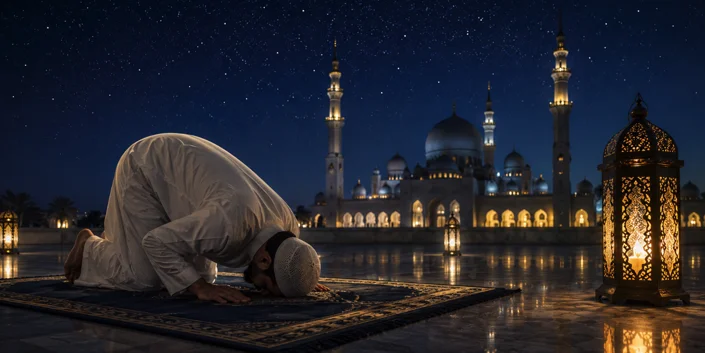
The Start and End Times of Isha Prayer and the Superiority of Delaying It
The time span for Isha is relatively long, but it has strict boundaries and special Sunnah recommendations in Islamic law.
Isha Prayer Start Time
When the twilight in the sky completely dissipates, and the sky loses its last gleam of light to enter pure darkness, the time for Isha officially begins.
Isha Prayer Last Time
It must be completed before the Islamic Midnight stipulated by Islamic law. The Islamic Midnight refers to the midpoint between sunset and dawn, and not necessarily the natural time of 12:00 AM.
The Wisdom of Time and the Superiority of Delaying
Contrary to the principle of performing Maghrib as early as possible, Prophet Muhammad (ﷺ) highly recommended appropriately delaying Isha. If conditions permit, such as a believer praying alone at home, delaying Isha to the first third of the night is a superior Sunnah. However, if going to the mosque, the virtue of following the congregation for collective prayer is much higher than delaying the prayer individually.
Isha Prayer How to Pray: Guide to Daily Routine Before and After Isha
Isha is not only an obligatory practice but also a routine guide for Muslims following the path of piety. Islamic law has clear regulations for life before and after Isha.
Avoid Falling Asleep Before Isha
After the time for Isha has entered and before completing the prayer, Islamic law strongly discourages believers from sleeping, because people can easily fall into deep sleep at night and thus miss this obligatory prayer.
Strictly Avoid Useless Chitchat After Isha
After completing Isha, the day's labor and spiritual practices are already complete. The Prophet strongly discouraged staying up late for meaningless conversations or entertainment after Isha. Believers should wash up and go to sleep as early as possible. This not only meets the requirement of keeping the body and mind clean but also ensures one can wake up early to perform Tahajjud and the next day's Fajr.
Abundant Spiritual Rewards and the Worship of Half a Night
Isha and Fajr often occur at the most tiring or sleepy moments of a believer's day. Therefore, persisting in these two prayers is a huge test of a believer's sincerity, for which Allah has prepared extremely abundant rewards.
Equivalent to the Worship of Half a Night
The Prophet explicitly taught that whoever participates in the collective prayer of Isha will receive a reward as if they had stood in prayer for half the night. If the believer then also participates in the collective prayer of Fajr, it is as if they had prayed the entire night.
Protection from Hypocrisy
According to Hadith records, overcoming laziness and persisting in going to the mosque to perform Isha and Fajr is considered an important sign of a believer staying away from Nifaq.
Core Advantages of QuranTime: Why Choose Us?
Pinpoint Local Prayer Times
Based on your device's real-time GPS coordinates, it uses highly accurate astronomical algorithms to ensure the exact start and end times of every prayer down to the second.
Punctual Adhan Playback and Reminders
Offers smart multidimensional reminders and supports Adhan audio playback, ensuring you never miss a conversation with Allah.
Support for Downloading and Printing Monthly Prayer Timetables
Generate and export a customized monthly prayer timetable for your city with one click, easy to print for your home or save to your phone's gallery.
Flexible Adaptation to Different Sects and Schools
Whether you follow ISNA, MWL, or the Karachi standard, and whether you belong to the Hanafi or Shafi'i school, you can switch the time algorithm with one click in the background.
Simple and Easy-to-Use Qibla Compass
Even when traveling or in unfamiliar surroundings, just open the app, and the fast compass will accurately lock onto the direction of the Kaaba for you.
Built-in Adhkar and Digital Tasbeeh
No physical prayer beads on hand after praying? Seamlessly switch to the app's post-prayer Adhkar and digital counter to complete your remembrance of Allah anywhere, anytime.
Ad-Free Interruption, Focus on Your Faith Journey
An extremely pure interface with a promise never to place commercial ads, preserving a clean and immersive spiritual space for you.
Rak'ahs and Recitation Structure of Isha Prayer
Isha consists of a total of six Rak'ahs, composed of the core obligatory prayer and the strongly recommended Sunnah prayer.
Fard: Four Rak'ahs, which is the core prayer that Muslims must complete.
Sunnah: Two Rak'ahs, which is the Sunnah performed after the obligatory prayer.
Core Recitation Rules Tip
The four Rak'ahs of the Isha Fard are a prayer combining aloud and silent recitation.
The first two Rak'ahs: Must be recited Jahri. The volume should be just loud enough for yourself and your immediate companions to hear.
The last two Rak'ahs: Must be recited Sirri. Believers should only silently recite Al-Fatihah in their hearts and should not make any obvious sound.
The Completion of Isha Prayer and the Indispensable Witr
Many beginners mistakenly believe that Isha is over after completing the two Rak'ahs of Sunnah. In fact, believers also need to complete Witr, known as the seal of the night prayer, which is an odd number of Rak'ahs.
Form of prayer: Witr is usually three Rak'ahs, and there are also forms such as a single Rak'ah in Islamic law. Before or after the Ruku in the third Rak'ah, believers need to recite a special supplication called Qunut.
Timing arrangement: The time for Witr lasts from after Isha until before dawn. If believers worry about not waking up on time late at night, the safest approach is to complete Witr immediately after the two Rak'ahs of Isha Sunnah before going to sleep. Some schools of thought, such as the Hanafi school, consider Witr to be a Wajib prayer that must be performed. Its status is extremely important and must never be neglected or omitted.
The Sacred Month of Ramadan: Isha and Taraweeh
During the holy month of Ramadan, Isha is followed by a grand annual practice. After completing the Fard of Isha and the two Rak'ahs of Sunnah, Muslims will collectively perform eight or twenty Rak'ahs of the intermittent prayer, namely Taraweeh. Afterwards, the congregation will collectively conclude the night prayer perfectly with Witr.
Isha Prayer FAQ
Q1: How should the Midnight in Islamic law be calculated? Does performing Isha after midnight count as a makeup prayer?

Q2: How should Isha be Qasr during travel? And how should it be Jam' with Maghrib?
Q3: Is it permissible to go straight to sleep after completing the four Fard Rak'ahs due to extreme fatigue and then make up the Witr prayer during the day the next day?
Q4: When joining the congregation at the mosque, if I only catch up with the Imam in the third Rak'ah, how should I make up the missed Rak'ahs after the prayer is finished?
Q5: When a woman performs Isha alone at home, must she also follow the ruling of Jahri for the first two Rak'ahs?