Maghrib Prayer Time: Urgent Timings and Recitation Rules

Islamic Namaz Time in
 Fajr
Fajr Dhuhr
Dhuhr Asr
Asr Maghrib
 Isha
IshaWhat is Maghrib Prayer?
Maghrib is the fourth of the five daily obligatory prayers in Islam. It is the sunset prayer that marks the end of the day and the official beginning of the night. As the hustle and bustle of the day gradually fades, Maghrib serves as an important spiritual hub for us to express gratitude for the day's blessings and pray for a peaceful night.
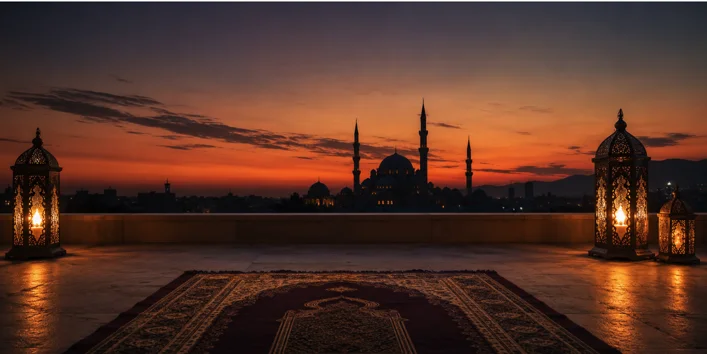
The Start and End Times and Urgency of Maghrib
Maghrib Prayer time today is not only closely related to magnificent natural phenomena but is also the most strictly timed among the five daily prayers.
Start Time
The moment when the sun's disc completely disappears below the horizon is sunset, which marks the start time of Maghrib.
End Time
Last time for Maghrib Prayer is when the red glow in the sky, namely the twilight, completely disappears and night fully falls, the time for Maghrib ends.
Time Warning: Sooner Rather Than Later
Maghrib Prayer times today has the shortest time window of the five daily prayers, usually lasting only 1 to 1.5 hours. Islamic law strongly advocates that once you hear the Adhan or confirm sunset, you should immediately put down your work, chores, or entertainment to pray without delay.
Core Advantages of QuranTime: Why Choose Us?
Pinpoint Local Prayer Times
Based on your device's real-time GPS coordinates, it uses highly accurate astronomical algorithms to ensure the exact start and end times of every prayer down to the second.
Punctual Adhan Playback and Reminders
Offers smart multidimensional reminders and supports Adhan audio playback, ensuring you never miss a conversation with Allah.
Support for Downloading and Printing Monthly Prayer Timetables
Generate and export a customized monthly prayer timetable for your city with one click, easy to print for your home or save to your phone's gallery.
Flexible Adaptation to Different Sects and Schools
Whether you follow ISNA, MWL, or the Karachi standard, and whether you belong to the Hanafi or Shafi'i school, you can switch the time algorithm with one click in the background.
Simple and Easy-to-Use Qibla Compass
Even when traveling or in unfamiliar surroundings, just open the app, and the fast compass will accurately lock onto the direction of the Kaaba for you.
Built-in Adhkar and Digital Tasbeeh
No physical prayer beads on hand after praying? Seamlessly switch to the app's post-prayer Adhkar and digital counter to complete your remembrance of Allah anywhere, anytime.
Ad-Free Interruption, Focus on Your Faith Journey
An extremely pure interface with a promise never to place commercial ads, preserving a clean and immersive spiritual space for you.
The Rak'ahs and Structure of Maghrib
Maghrib consists of a total of 5 Rak'ahs, comprising the mandatory Fard and the highly recommended Sunnah.
Fard: 3 Rak'ahs, the core prayer that must be completed.
Sunnah: 2 Rak'ahs, the post-prayer practice that Prophet Muhammad (ﷺ) consistently performed daily.
Important Recitation Rules Tip
Maghrib is a prayer with a unique combination of aloud and silent recitation, marking the transition from daytime silence to nighttime vocalization:
The first two Rak'ahs: Must be recited aloud (Jahri). The volume should be just loud enough for yourself and your immediate companions to hear.
The third Rak'ah: Must be recited silently in the heart (Sirri). Except for the slight movement of your lips, no obvious sound should be made.
Maghrib Prayer Rakat: Step-by-Step Prayer Guide and the 3-Rak'ah Fard Process
The 3-Rak'ah structure of Maghrib is an excellent advanced practice for beginners, especially the transition between the first sitting and the final sitting. Here is the complete 3-Rak'ah Fard process:
The First Rak'ah: Recited Aloud
1. Entering Prayer and Recitation: After forming the intention, say "Allahu Akbar" to enter the prayer. Recite Al-Fatihah aloud, followed by any other chapter from the Quran aloud.
2. Ruku and Sujud: Complete the Ruku, stand up straight, and then perform two Sujuds.
3. Standing Up: After the second Sujud ends, stand straight up to enter the second Rak'ah.
The Second Rak'ah: Recited Aloud and the First Sitting
1. Recitation: Continue to recite Al-Fatihah aloud along with another short chapter.
2. Ruku and Sujud: Complete the Ruku and two Sujuds in the same manner.
3. [Key Point] First Sitting: Do not stand up after the second Sujud; instead, sit down. Silently recite the sitting supplication called Tashahhud in your heart. After finishing, stand straight up to enter the third Rak'ah.
The Third Rak'ah: Silent Recitation and the Final Sitting
1. Recitation: In this Rak'ah, only recite Al-Fatihah, do not recite any other chapter, and it must be recited silently in the heart.
2. Ruku and Sujud: Complete the Ruku and two Sujuds.
3. [Key Point] Final Sitting: Sit down after the second Sujud ends. Sequentially recite Tashahhud, the Salawat for blessing the Prophet, and a brief Dua in your heart.
4. Tasleem: Turn your head to the right and say "Peace and blessings of Allah be upon you", then turn your head to the left and repeat it. This successfully concludes the 3-Rak'ah Fard prayer.
Maghrib and Iftar: A Sacred Intersection
Whether during the holy month of Ramadan or when observing voluntary fasts like those on Mondays and Thursdays, the timing of Maghrib perfectly coincides with the most anticipated moment of a Muslim's day—Iftar.
At the hungry hour of sunset, Islamic law provides us with a perfect lifestyle that balances faith and physiological needs, which is also a Sunnah highly praised by the Prophet:
1. Break Fast Quickly: Upon hearing the sunset call to prayer, first eat a few dates and drink a glass of water to rapidly relieve the day's thirst and low blood sugar.
2. Pray Immediately: After slightly lining your stomach, get up immediately to complete the Maghrib prayer.
3. Enjoy the Main Meal: After finishing the prayer and nourishing both body and soul, sit down to calmly enjoy a hearty main meal.
Tip: Never delay or miss the extremely short Maghrib prayer by indulging in a table full of sumptuous food.
The Golden Hour as Night Falls: Salat al-Awwabin
The brief night period between Maghrib and Isha is considered full of blessings in Islamic tradition. If you still have plenty of time after completing the 3-Rak'ah Fard and 2-Rak'ah Sunnah of Maghrib, it is highly recommended that you try an advanced post-prayer practice, namely Salat al-Awwabin, which means the prayer of those who repent or return to Allah.
How to Pray
It takes the form of 2 to 6 Rak'ahs of Nafl prayer, usually offering Tasleem after every 2 Rak'ahs.
Abundant Reward: According to Hadith records, if a believer performs 6 Rak'ahs of Salat al-Awwabin after Maghrib and does not say any evil words or do anything useless during this period, the reward for this short prayer of about ten minutes is equivalent to 12 years of worship.
Try your best to stay on your prayer mat during this "golden hour" transitioning from daytime clamor to nighttime tranquility. Whether performing Salat al-Awwabin, reciting the Quran, or reciting Adhkar, it can infuse your night with infinite peace and blessings.
Maghrib Prayer FAQ
Q1: When traveling or on a business trip, can Maghrib be shortened (Qasr) like other prayers?

Q2: What should I do if I accidentally miss Maghrib because I am too busy and only remember when it's time for Isha?
Q3: Does Maghrib have a delayed time that is disliked (Makruh) in Islamic law?
Q4: What should I do to complete my prayer if I join the congregation at the mosque but only catch up with the Imam during the 3rd Rak'ah?
Q5: When a woman prays Maghrib alone at home, must she also recite the first two Rak'ahs aloud (Jahri)?